AI Integration for SMEs: Where to Start and What to Skip
 Gianpiero Vecchi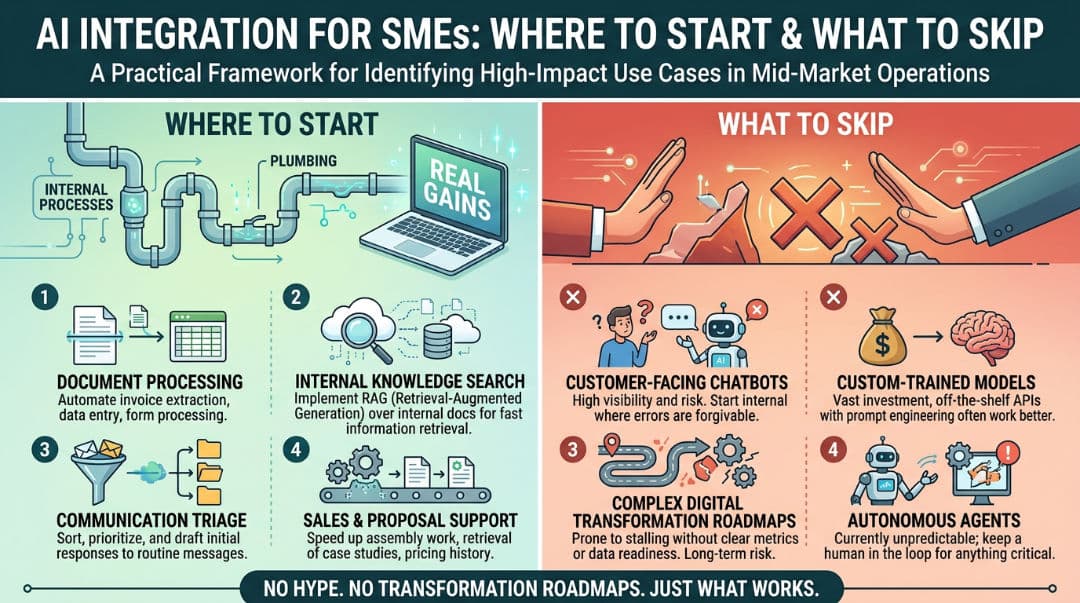
I talk to mid-market business owners almost every week. The conversation usually starts the same way: "We know we need AI, but we have no idea where to begin."
That's fair. There's a lot of noise. Every SaaS vendor has rebranded as an "AI company," every consultant has a transformation framework, and your LinkedIn feed is full of people who apparently automated their entire business over a weekend. They didn't.
Here's what I've actually seen work after doing this for a while.
Most companies start in the wrong place
The instinct is to go big. A customer-facing chatbot. A custom model trained on company data. A six-month digital transformation roadmap with a steering committee.
These sound great in a board meeting. They also tend to stall within three months because the data isn't clean, the scope keeps growing, and nobody agreed on what success looks like in the first place.
The businesses I've seen get genuine value from AI started with something no one would put on a slide deck. Invoice processing. Email triage. Meeting note summaries. Internal search that actually returns useful results instead of a list of file names from 2019.
Nobody posts about automating their accounts payable workflow. But that's usually where the money is.
Three questions before you greenlight anything
I run every potential AI project through the same filter. It's simple but it kills bad ideas quickly.
Is someone doing this task repeatedly, and wishing they weren't? Repetitive, low-judgment work is where AI tools deliver today. If the task needs nuance, institutional knowledge, or the ability to read a room, you'll be disappointed. A model can classify support tickets all day long. It cannot tell whether a client's "fine, go ahead" means they're happy or they've given up on you.
Can you put a number on it? "Improve customer experience" isn't measurable. "Cut average response time from 4 hours to 45 minutes" is. Without a clear before-and-after metric, you won't know if the project worked. More importantly, you won't be able to justify the next one to whoever holds the budget.
What happens when it gets it wrong? Every AI system makes mistakes. Some are annoying (misrouting an internal support ticket). Some are expensive (sending a wrong price quote). Some are dangerous (misclassifying a medical result). Start where errors are cheap.
What to skip, at least for now
Custom-trained models. Unless you're processing millions of domain-specific documents, you don't need one. Off-the-shelf APIs with decent prompt engineering cover most use cases at a fraction of the cost. I've watched companies spend six figures training models that performed worse than a well-written system prompt on Claude or GPT.
Customer-facing chatbots as project number one. They're visible, which makes them risky. Your first AI project should be internal, where mistakes are forgivable and you can iterate quietly. A botched chatbot interaction gets screenshotted and posted on Twitter. A slightly wrong internal document summary just gets corrected.
Any tool that "requires organizational change" first. If a vendor says you need to restructure your team or shift your culture before their product delivers results, that's not a tool. That's a consulting engagement wearing a software mask. Good tools fit into existing workflows.
Autonomous agents handling real business processes. Agents look great in demos. In production, they do unexpected things. I keep a close eye on this space and the technology is improving fast, but for anything that touches customers or money, keep a human in the loop. Maybe revisit next year.
Where the actual wins are
Document processing is probably the single highest-ROI starting point for most mid-market companies. Extracting data from invoices, contracts, forms. It's boring and reliable. I still find companies where people spend hours each week manually keying numbers from PDFs into spreadsheets. This is a solved problem.
Internal knowledge search is the other obvious one. Teams waste hours looking for information scattered across shared drives, old email threads, and wikis nobody has touched since 2022. RAG (retrieval-augmented generation) over your internal docs is one of the few AI applications that pays for itself consistently. Not because the tech is magic, but because the bar is so low. If your current "search" is Control+F in a SharePoint folder, almost anything will be an improvement.
Communication triage is less glamorous but worth the effort. Sorting, prioritizing, and drafting initial responses to routine messages. I'm not talking about full automation. Just getting the first draft right and routing things to the correct person faster. Even cutting response time by 30% compounds into real savings over a year.
Sales and proposal support. The assembly work behind proposals, pulling case studies, pricing history, relevant specs, can eat entire afternoons. AI handles this well because it's mostly retrieval and formatting. The salesperson still owns the relationship and the final document. They just get to skip the part they hate.
How to actually start
Pick one process. Internal, repetitive, measurable. Spend two weeks watching how it actually works in practice, not how the process document says it works (those are never the same thing). Talk to the people who do the task every day, not their managers.
Then build the simplest version that could possibly work. An n8n workflow hooked up to an API. A Google Sheet with an OpenAI integration. Whatever gets you from "idea" to "working thing you can test" in days, not months.
Run it alongside the existing process for a few weeks. Measure the difference. If it works, expand. If it doesn't, you've lost two weeks and maybe a few hundred dollars in API costs. That's the right size for a first experiment.
The part nobody wants to hear
Most AI integration work isn't glamorous. It's plumbing. You're connecting systems, cleaning messy data, writing prompts, and debugging edge cases that show up on day three because someone in accounting uses a date format nobody expected.
The companies getting real value from AI right now aren't the ones with the most advanced tech. They're the ones that bothered to understand their own processes first. That's the unsexy prerequisite nobody mentions at conferences.
The best AI project for your company is probably not the one you saw demoed at a trade show last month. It's the one your operations person has been quietly complaining about for the last three years. Go talk to them.